

Allegheny Health Network’s media relations team is dedicated to providing reporters and other members of the news media with the assistance they need.
Tuesday, May 05, 2026
Allegheny Health Network Brings Mako Robotic Arm Assisted Knee and Hip Surgeries to Grove City Hospital
GROVE CITY, Pa. — After more than 40 years working in health care and now helping oversee operations at Allegheny Health Network’s (AHN) Grove City Hospital, Judy Frontain suddenly found herself facing a challenge she had spent her career helping others navigate: debilitating pain.
“My knee was bone-on-bone and the pain was probably an eight out of ten all the time,” said Frontain, 69, manager of hospital operations at AHN Grove City Hospital. “I could barely walk, and even getting into a car was difficult.”
Despite her knee pain, Frontain continued working long days in the hospital, often logging tens of thousands of steps.
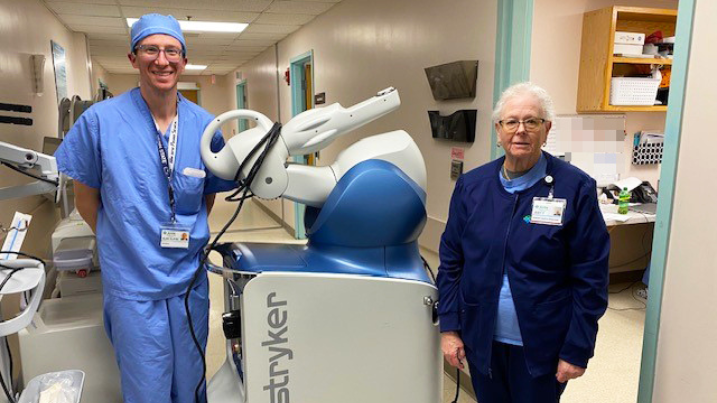
In November 2025, she became one of the first patients at Grove City Hospital to undergo robotic-assisted knee replacement using the Mako SmartRobotics™ system, a cutting-edge technology now available locally through the AHN Orthopaedic Institute.
“The technology is amazing and my recovery has been great,” Frontain said. “I can do everything I want to do again: walking every day, working out at the YMCA, and being back at work.”
On her first day back on the job, she logged nearly 26,000 steps.
“I should have done the surgery sooner,” she said.
The Mako™ system allows surgeons to perform highly precise knee and hip replacement procedures using a robotic arm that assists with bone preparation and implant placement.
According to Alan Slipak, MD, an orthopaedic surgeon with the AHN Orthopaedic Institute, bringing the technology to Grove City ensures patients in Mercer County and surrounding communities have access to the same advanced surgical tools available at larger hospitals within the network.
“Robotic-assisted joint replacement allows us to perform surgery with a level of precision that simply wasn’t possible with traditional manual techniques,” said Dr. Slipak. “Our goal is to optimize implant positioning, stability and ligament balance, which can help improve function and long-term outcomes.”
Before surgery, the system uses a computed tomography (CT) scan to create a detailed 3D model of the patient’s joint. Surgeons then develop a personalized surgical plan based on the patient’s anatomy. During the procedure, the robotic arm assists the surgeon in removing damaged bone and cartilage within predefined boundaries, helping ensure the surgical plan is executed accurately.
“The surgeon is always in control,” said Dr. Slipak. “The robot doesn’t perform the surgery on its own. It’s a highly precise tool that helps us carry out the plan exactly as intended.”
Joint replacement surgery is most commonly performed to treat end-stage osteoarthritis, when cartilage loss causes severe pain, stiffness and reduced mobility.
With advances in robotic technology and surgical techniques, many patients are now able to recover more quickly than in the past.
“Most patients having robotic knee replacement today are going home the same day and doing their therapy at home,” Dr. Slipak said. “Recovery is typically two to three months for most daily activities, with continued improvement over the first year.”
Across AHN, robotic-assisted joint replacement continues to expand. As of December 2025, surgeons have completed more than 1,050 Mako procedures at AHN Canonsburg Hospital, with additional programs growing across the network.
Dr. Slipak believes robotic-assisted technology will soon become the standard approach to joint replacement surgery.
“In 20 years, it will likely be rare to perform a joint replacement without some form of robotic assistance or navigation,” he said. “What’s exciting is that patients in Grove City don’t have to wait for the future, they already have access to it.”
Mako™ Robotic-Arm-assisted surgery is also available at AHN’s Allegheny General, Canonsburg, Forbes, Saint Vincent, and West Penn Hospitals. To learn more, visit www.ahn.org/orthopaedic.