

AHN offers complex treatment when others can't
Donna was diagnosed with a type of cancer so rare, many doctors never encounter it. After doctors near her home left her feeling desperate, she found the expertise she needed 200 miles away, with oncology specialists at AHN.
After an extensive 11-hour surgery by an AHN Cancer Institute surgical oncology team, Donna isn't just living her best life — she's giving much-needed hope to other AHN cancer patients.
Local doctors offered little hope
As Donna approached retirement from her engineering career, the New York native noticed that she was gaining weight and feeling bloated, which she chalked up to her age and sedentary job. But when her symptoms continued after she retired and was able to be more active, she knew something was wrong.
An ultrasound with her primary care doctor revealed fluid in her abdomen and spots on her liver and one of her kidneys. She went to a regional cancer center for more imaging — a CT scan — which showed that the spots on her organs were nothing to be concerned about. But the fluid in her abdomen was mucus from an extremely rare, aggressive cancer: pseudomyxoma peritonei (PMP).
With PMP, mucinous or jelly-like tumors grow in the lining of the abdominal cavity, called the peritoneum. The tumors produce a sticky fluid that can fill the abdomen and choke off other organs. By the time PMP is discovered, the tumors are so widespread that many specialists won't take on these complex cases like Donna's. Add to that the historically limited treatment options, and most people with PMP have very grim outlooks.
That was initially the case with Donna. "My doctors here in New York didn't have the confidence or experience to treat me," she recalled. "They told me I only had months to maybe a year to live."
It was a shocking diagnosis, but the prognosis was particularly devastating.
Donna continued, "It was surreal. I kept thinking, 'They can't be talking about me.'"
But Donna wasn't going to stand by and let cancer shut down her body. "My husband and I Googled everything," she explained. "We left no stone unturned. That's when we found a PMP advocacy group on Facebook."
Members in the group were posting about how cancer specialists at AHN were treating patients with complex cases just like Donna's. One of the members sent her a link to AHN's second opinion webpage. Within only 45 minutes of submitting her information, an AHN nurse navigator called Donna to set up her appointment with Patrick Wagner, MD, a surgical oncologist and the director of Complex General Surgical Oncology, specializing in treating complex abdominal cancers.
Donna had her first appointment a week later. This time, she felt reassured by her doctor. "Dr. Wagner listened to me — what I've been through, what other doctors had already told me. Then he said, 'You need a plan for decades of life.'"
A go-to destination for PMP patients
Dr. Wagner and other surgical oncologists at AHN Cancer Institute perform what's called cytoreductive surgery in the abdominal cavity, where all visible tumor masses are intricately removed. It's an intensive procedure that can take more than 12 hours to complete.
Once the visible tumors are removed, the surgical team uses hyperthermic intraperitoneal chemotherapy (HIPEC), during which a heated chemotherapy bath circulates within the abdominal cavity to target any microscopic cancer cells that may still be left behind.
"Donna's cancer is extremely rare, and some health systems aren't set up for such a highly technical treatment like we are," explained Dr. Wagner. "So people travel from quite a distance to AHN Cancer Institute. We typically see 10 new patients with PMP each week."
Donna spent 11 days in the hospital and then stayed with family in Pittsburgh for another week before Dr. Wagner gave her the OK to travel home.
"It took me a good four or five months to get my strength back," Donna recounted. "There were times I couldn't see the light at the end of the tunnel. I couldn't eat anything. I felt weak. I was miserable."
She and her husband decided to plan a trip. And just five months after surgery, they boarded a plane to Iceland.
"That was a huge turning point. Every step I took, I told myself, 'I can do this.' I didn't look back after that."
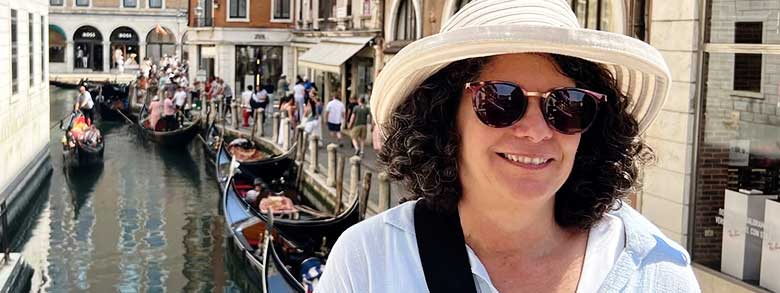
And in the years since, Donna's traveled to England, Scotland, and Italy. Everywhere she goes, she's walking instead of taking taxis. "It's good for me," she said. "Besides, you can see a lot of beauty in the world if you just get out and walk."
And between her international trips, she walks five miles every day and hikes in the Adirondack Mountains as often as she can.
Inspired by the guidance of experts
From Dr. Wagner's perspective, Donna's case has been a huge success.
"Donna went through a very intense procedure," he remarked. "We use minimally invasive techniques, but the recovery still takes months. And to see her enjoying such a good quality of life, it's incredibly rewarding."
And Donna knows she's still in good hands.
"As time goes on, there's always a chance the cancer comes back. It's been almost three years since my surgery, and I still trust Dr. Wagner to help guide me along the way. He's my guardian angel."
The exceptional care she's received from the entire Cancer Institute team inspired Donna to become a guardian angel of her own, supporting others who have been diagnosed with cancer as a patient ambassador.
"I've been through the journey. I know what people are going through in their journeys. As an ambassador, I meet people in their dark places and show them there is hope."
Breakthrough care for rare and complex cancers
The AHN Molecular, Metastatic, and Rare Cancers Center of Excellence focuses on innovation to diagnose and treat complex, advanced, and rare cancers. We offer expertise and resources that few health systems can match, including precision oncology, genomic testing and genetic counseling, state-of-the-art technologies and techniques, access to groundbreaking clinical trials, and support for the whole patient.
The center uses a collaborative, multidisciplinary approach, including oncologists, molecular pathologists, radiologists, surgeons, and specialized oncology nurses. Bringing together this broad base of knowledge and pioneering approach helps us offer personalized care for our patients, so they can have the best possible results.