

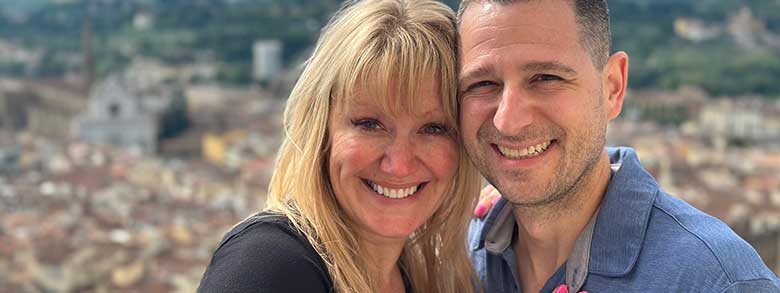
She didn't give up, neither did her team
After years of setbacks, surgeries, and second chances, one patient's path to motherhood shows what persistence — and the right care — can make possible.
Brandee Fantini didn’t wait for the phone call. She didn’t need to.
Less than 24 hours after her embryo transfer, she felt something different this time. By day five, the home test confirmed it. By day 10, the blood work did too. Still, experience had taught her to be cautious.
“At our first ultrasound, I was nervous and hopeful, but trying not to get ahead of myself,” Brandee, the 50-year-old from Butler, Pennsylvania, said about her visit to AHN. “The last time, this was when they told us the pregnancy wasn’t viable.”
She had a quiet rule: If the nurse walked in holding ultrasound photos, it was good news.
“So, when she came in with a roll of pictures,” she said, “my heart just soared.”
A journey defined by persistence
Brandee’s path to that moment began years earlier — filled with determination, setbacks, and the kind of resilience that can’t be measured.
After getting married in 2021, she and her husband, Joshua, began trying to grow their family. Based on prior testing, they knew they would likely need help from fertility specialists, so they turned to the AHN Center for Reproductive Medicine.
What followed was an experience many patients don’t fully anticipate: not just one procedure or one decision, but an ongoing process that evolves over time.
"Over the next few years, Brandee endured numerous tests — an incalculable amount of blood work, ultrasounds, and multiple surgeries,” said Meredith Snook, MD, AHN reproductive endocrinology and infertility specialist. “Along with that came an emotional roller coaster of outcomes.”
There were IVF cycles that didn’t produce viable embryos. A pregnancy that ended in miscarriage. More procedures. More waiting.
“Yet through it all, she never lost her sense of humor,” Dr. Snook said. “She stayed optimistic and trusted that we would get her there.”
Understanding IVF and why it's not always simple
For many patients, in vitro fertilization (IVF) becomes a key part of the journey. But it’s rarely straightforward.
IVF is a process where eggs are retrieved from the ovaries, fertilized with sperm in a lab, and then transferred into the uterus as embryos. It’s one of the most effective forms of assisted reproductive technology, but success depends on many factors, including age, egg and embryo quality, and the condition of the uterus.
Even in ideal situations, it can take multiple cycles to achieve a successful pregnancy. And for patients with underlying conditions — like fibroids or endometriosis — the process can be even more complex.
“No two fertility journeys are alike,” Dr. Snook said. “We frequently adapt and refine our strategies, always aiming to maximize each patient’s chance of a successful pregnancy.”
For Brandee, IVF was the right path, but it wasn’t the only part of the story.
When the uterus needs a reset
As her care team worked to understand why previous attempts hadn’t succeeded, they identified a key issue: a fibroid.
Fibroids are noncancerous growths in or around the uterus. Depending on their size and location, they can interfere with embryo implantation or increase the risk of miscarriage by distorting the uterine cavity or affecting blood flow.
“At first, it wasn’t directly in the uterus,” Brandee said. “But over time, it moved into the wall.”
That shift made it harder for an embryo to implant and grow. What came next didn’t happen in pieces — it came together.
Within AHN Women’s Health, Brandee’s care didn’t live in one office or with one physician. Her fertility team, surgeon, and imaging specialists worked in step, sharing information, adjusting the plan, and moving quickly when something changed. They collaborated with the same goal in mind: giving her the best possible chance at a healthy pregnancy.
“To optimize the uterus for pregnancy, we needed to remove the fibroid,” said AHN gynecologic surgeon Noah Rindos, MD. “Our goal is always to create the best possible environment for carrying a pregnancy to full term.”
A minimally invasive solution with major impact
The procedure Brandee needed is called a laparoscopic myomectomy, a minimally invasive surgery that removes fibroids through small incisions.
“It’s done through four small incisions, each less than an inch,” Dr. Rindos explained. “It allows us to remove the fibroid while preserving the uterus.”
During the same procedure, he also addressed another condition affecting her fertility — endometriosis.
What endometriosis is and why it matters
Endometriosis occurs when tissue similar to the lining of the uterus grows outside of it, often on the ovaries, fallopian tubes, or surrounding pelvic structures. For many patients, it causes pain and heavy bleeding. But it can also affect fertility by creating inflammation, scar tissue, or changes in how the reproductive system functions.
“Pain and bleeding are the two big symptoms,” Dr. Rindos said. “But from a fertility standpoint, it can also interfere with how the body supports a pregnancy.”
Endometriosis affects a significant number of people experiencing infertility. While it can make conception more difficult, many patients still go on to have successful pregnancies — with the right treatment approach.
AHN offers various treatment options, depending on each patient’s situation. In some cases, medication can help manage symptoms. In others, especially when fertility is a goal, surgery may be recommended to remove the endometrial tissue and improve the chances of pregnancy.
A coordinated plan, built in real time
One of the defining parts of Brandee’s story is how quickly her care team adapted. When it became clear the fibroid couldn’t be fully treated through a less invasive procedure, her doctors moved fast.
“I called Dr. Rindos immediately,” Dr. Snook said. “We developed a plan, ordered imaging, and had her seen within a week.”
That kind of coordination — across specialties — can make a meaningful difference, especially when timing matters.
“Brandee’s path to pregnancy is really the definition of a team approach,” Dr. Snook added.
Healing, setbacks, and then perfection
After surgery, there was more waiting, recovery, and healing. Time for her body to be ready again.
“I was off work for five weeks and had to wait six months before we could even try another transfer,” Brandee said.
Even then, the path wasn’t perfectly smooth. Another cycle was canceled. Another procedure followed. But then came June.
“This was the magic cycle,” Brandee said.
That’s because everything aligned. Her uterine lining developed as expected. The embryo transfer went forward. The early signs were promising.
“We transferred her embryo, and when the pregnancy test came back positive, there were cheers in the office,” Dr. Snook said.
From there, the pregnancy progressed normally — something that once felt uncertain, now unfolding exactly as hoped. Because of Brandee’s prior surgery, her delivery was carefully planned as a cesarean section at 37 weeks.
And then, finally, on February 18, 2026, “Fox Ryan arrived at 10:17 a.m.,” Brandee said. “Six pounds, 12 ounces. Perfect.”
Now for Brandee and Joshua, life is exhausting but so joyful.
“Crazy in the best way,” Brandee said about caring for their little boy. “Our world revolves around him now, and I wouldn’t trade a single second of it.”
She calls him their “rainbow miracle baby” — a reminder of everything it took to get here.
The team behind her dream
Ask Brandee what made the difference, and she won’t point to just one moment. It was the people.
“I’m so incredibly grateful to the entire AHN team who supported me every step of the way,” she said.
She remembers one nurse in particular.
“She was my ‘fantastical fertility fairy,’” Brandee said. “She held my hand when we got the worst news and cried with me when we finally got the best.”
For her physicians, the outcome is meaningful, but the journey is just as important.
“Brandee is the true MVP of this story,” Dr. Snook said. “Her persistence, determination, and resilience are what made this possible.”
And for the team, it reinforces why they do what they do.
“We want every patient to have the chance to build the family they want,” Dr. Rindos said.
And for Brandee, the story of building her family may not be finished yet.
“I already have an appointment to talk about transferring another embryo,” she said.
Because even after everything it took Brandee — and many other women — to get here, she’s ready to believe in what’s possible all over again.