

Leading Innovations in Melanoma and Skin Cancer Care at AHN
Published Jan 16, 2026
While melanoma has historically accounted for a majority of skin cancer-related deaths, recent data shows a 99% five-year relative survival rate for those with localized disease.* The decline in mortality is correlated with advancements in technology to detect malignancy early, and targeted therapies that provide more effective treatment.
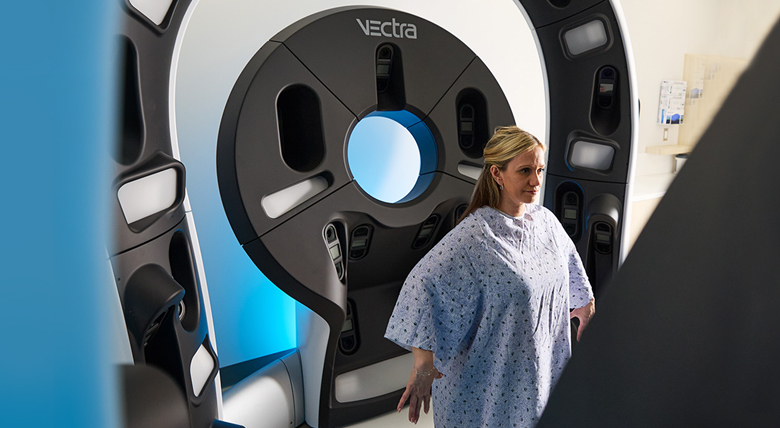
AHN Cancer Institute’s Melanoma and Skin Cancer Center of Excellence is at the forefront of these advancements, offering the region’s only VECTRA® WB360 Imaging System for enhanced diagnostic accuracy and multidisciplinary care that improves patient outcomes.
Detecting skin cancer sooner
As one of only 20 clinics in the U.S. with the VECTRA WB360 Imaging System — and the only one in western Pennsylvania — the AHN Melanoma and Skin Cancer Center of Excellence can provide a whole-body, 3D video examination to establish patient baselines and monitor skin lesions, moles, and other dermatologic conditions.
Designed specifically for dermatology, the system rotates cameras around patients to capture the entire skin surface in macro quality resolution within seconds.
“The VECTRA technology has transformed our diagnostic process,” said Deanna Huffman, DO, oncologist at AHN Cancer Institute. “It’s a noninvasive way to visualize the skin and capture detailed images that can be monitored over time, enabling early detection of abnormalities and providing patients peace of mind.”
In addition to the VECTRA system, AHN offers a range of advanced noninvasive and minimally invasive diagnostic modalities, including:
- Biopsy-based assays, including ctDNA analysis to detect tumor DNA fragments released into the bloodstream.
- Non-invasive sampling techniques, such as tape-strip testing to gently collect epidermal cells for analysis.
- Genomic profiling to determine risk of metastatic progression and disease recurrence.
Advanced therapies for melanoma
Ongoing clinical trials investigating Tumor-Infiltrating Lymphocyte (TIL) therapy are demonstrating promising efficacy in the treatment of melanoma. This approach involves harvesting T cells from a patient’s tumor, expanding the tumor-reactive lymphocyte population ex vivo, and re-infusing the cells to enhance anti-tumor immune activity.
As one of few centers capable of manufacturing TIL products in-house, AHN offers an accelerated 10-day timeline from melanoma diagnosis to TIL infusion for eligible patients with advanced disease. This rapid turnaround is crucial in combatting melanoma’s aggressive progression and frequent resistance to systemic therapies.
Recent clinical trials have demonstrated that even six months of immunotherapy for metastatic melanoma can yield significant and lasting benefits, with many patients experiencing long-term survival of five years or more. Immunotherapy has also changed the treatment landscape for skin cancers like squamous cell carcinoma and basal cell carcinoma, which historically had limited treatment options.
Comprehensive and compassionate care
AHN’s multidisciplinary model gives patients timely access to a team of specialists, including:
- Dermatologists
- Medical oncologists
- Oncodermatologists
- Radiation oncologists
- Skin care specialists
- Surgeons
Providers across specialties review factors such as family history, previous skin cancers, patterns of sun exposure, and variations in individual skin profiles to assess risk and provide personalized treatment plans.
“Evaluating each patient holistically allows us to build relationships, account for their lifestyle, and approach their diagnosis with treatment most effective for them,” said Dr. Huffman.
How to refer
Patients with multiple atypical lesions, irregular moles, extensive photodamage, or spots that appear discordant with their baseline skin pattern may benefit from screenings. If you identify a concern or your patient reports something new or evolving, refer them to AHN Cancer Institute’s Melanoma and Skin Cancer Center of Excellence by calling 412-578-HOPE 412-578-4673.
*
Survival Rates for Melanoma Skin Cancer. Cancer.org.
Published Jan 16, 2026
About Deanna Huffman, DO
Dr. Huffman is a board-certified oncologist who specializes in diagnosis and targeted treatment of skin cancers, including melanoma.
About AHN Cancer Institute
AHN Cancer Institute offers the latest innovations and treatments, and a navigation team to guide you through. The AHN Cancer Navigation Team is your advocate and single point of contact from day one of your cancer journey. They manage all the details, big and small, so you can focus on healing. When you have cancer, AHN is exactly where you want to be.