

Seeing is believing
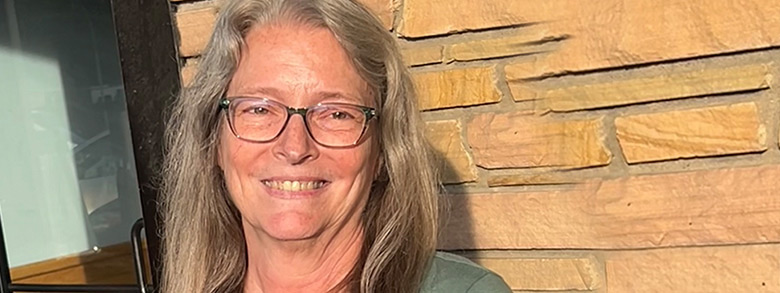
She had slowly lost the ability to clearly see the world around her. After a rare double cornea transplant, familiar faces, daily routines, and the details of life began coming back into view.
For years, Cindy Lee’s world faded in and out like a fogged-up window.
Some mornings, her vision seemed manageable. By evening, faces blurred into shadows, and she was unable to recognize someone standing just a few feet away.
Cindy, 59, gave up driving at night. Movies and concerts lost their magic. At work, she needed a larger monitor to read text on a screen. She began relying on others — including her husband, Bob — to help her get through everyday life.
“I was losing my sense of independence,” Cindy said. “I depended on others to drive and even help me recognize people.”
What Cindy didn’t know then was that a rare eye disease had been quietly changing the clear front surface of both of her eyes for years. And eventually, it would lead her to a highly specialized procedure at AHN that would give her vision — and her life — back.
A disease hiding in plain sight
About 20 years ago, Cindy was diagnosed with Fuchs’ endothelial dystrophy, often called Fuchs dystrophy.
The condition affects the cornea — the clear outer layer at the front of the eye that helps focus light. Healthy corneas stay clear because of a thin layer of cells that pump out extra fluid. In people with Fuchs dystrophy, those cells slowly die off too early. As fluid builds up, the cornea swells and vision becomes cloudy or blurry.
“Many people have never even heard of Fuchs dystrophy,” said Deval Paranjpe, MD, AHN corneal and cataract surgeon and chair of AHN Ophthalmology. “The disease often doesn’t show symptoms until people are in their 50s or 60s.”
For Cindy, routine eye exams first revealed signs of the disease. Her optometrist referred her to Dr. Paranjpe, who carefully monitored her condition for years.
At first, the disease progressed slowly. But as time went on, everyday tasks became harder.
“Dr. Paranjpe was very conservative,” Cindy said. “We agreed to take no action until it became necessary.”
When waiting was no longer an option
Over time, Cindy also developed cataracts in both eyes. Dr. Paranjpe warned her that cataract surgery could speed up the progression of her Fuchs dystrophy, and it did. After surgery on her left eye, her cornea began to fail. That meant it was finally time for a corneal transplant.
The idea terrified Cindy.
“The thought of transplanting anything is extremely worrisome,” she said. “Something as precise as microscopic tissue in your eye is a whole different level.”
But Dr. Paranjpe walked her through every possibility and answered every question.
“She explained every possible scenario,” Cindy said. “I didn’t encounter anything she hadn’t already talked with me about.”
A precise procedure
To restore Cindy’s vision, Dr. Paranjpe performed a procedure called DSEK, short for Descemet’s Stripping Endothelial Keratoplasty.
Instead of replacing the entire cornea, DSEK replaces only the damaged inner layer of cells. This allows for a smaller incision and often a faster recovery than a full corneal transplant. During the procedure, healthy donor tissue is carefully placed inside the eye and held in position with a small air or gas bubble.
The donor corneal tissue comes from people who chose to become organ donors. Because the cornea has no blood supply, patients usually do not need donor matching the way other organ transplants often do.
“The generosity of organ donors makes these surgeries possible,” Dr. Paranjpe said.
The surgery itself can take less than an hour. But recovery requires patience — and stillness.
Recovery flat on her back
After surgery, Cindy had to lie flat on her back for two days so the gas bubble could hold the donor tissue in place while it healed. Patients can only get up briefly to eat or use the restroom. Activities that cause vibration — even using an electric toothbrush — are restricted during early recovery.
Cindy’s first transplant in her left eye did not heal the way doctors hoped.
A second procedure using another gas bubble did not solve the problem. Eventually, she needed another transplant, which proceeded very well.
“My vision was immediately clearer,” she said.
Later, Cindy underwent cataract surgery and another successful DSEK procedure in her right eye. From the first surgery to the final recovery, the journey lasted about two years.
Seeing life clearly again
Today, Cindy says the difference is life changing.
The fogginess is gone. She can drive again — day or night. She can recognize faces. She no longer needs enlarged text on oversized computer screens at work.
Most importantly, she no longer fears losing her independence.
“I’m able to live life to the fullest again,” she said.
Cindy spends her time enjoying outdoor activities, swimming, riding motorcycles, and making memories with her children and two granddaughters.
She is deeply grateful for the care she received at AHN throughout her journey.
“Every person treated me as if they truly cared about my experience and outcome,” she said.
Knowing when to seek help
Dr. Paranjpe encourages people not to ignore changes in their vision.
Blurred vision, trouble driving at night, glare, or difficulty reading — even with glasses — can all be signs that something more serious is happening.
“If your vision is affecting your daily life, it’s time to get checked,” Dr. Paranjpe said.
Regular eye exams can help detect conditions like Fuchs dystrophy and cataracts early, sometimes before symptoms become severe.
For Cindy, that care — combined with advanced treatment and persistence through a difficult recovery — helped bring the world back into focus.
About AHN Ophthalmology
We offer a full spectrum of advanced eye care services, including treatment for cornea and external disease; retinal surgery; cataract surgery; oculoplastic and orbital surgery; retinal screenings, comprehensive eye exams; and management of conditions like dry eye, macular degeneration, and thyroid eye disease.
In addition to Dr. Paranjpe, AHN Ophthalmology includes these specialists:
Randall Beatty, MD, orbital and oculoplastic surgeon
Michael Lewen, MD, retinal surgeon
Thierry Verstraeten MD, retinal surgeon
Paul Freeman, OD, optometrist and vision rehabilitation specialist
Contact us
Call 412-359-6300 to request an appointment with AHN Ophthalmology at Allegheny General Hospital.